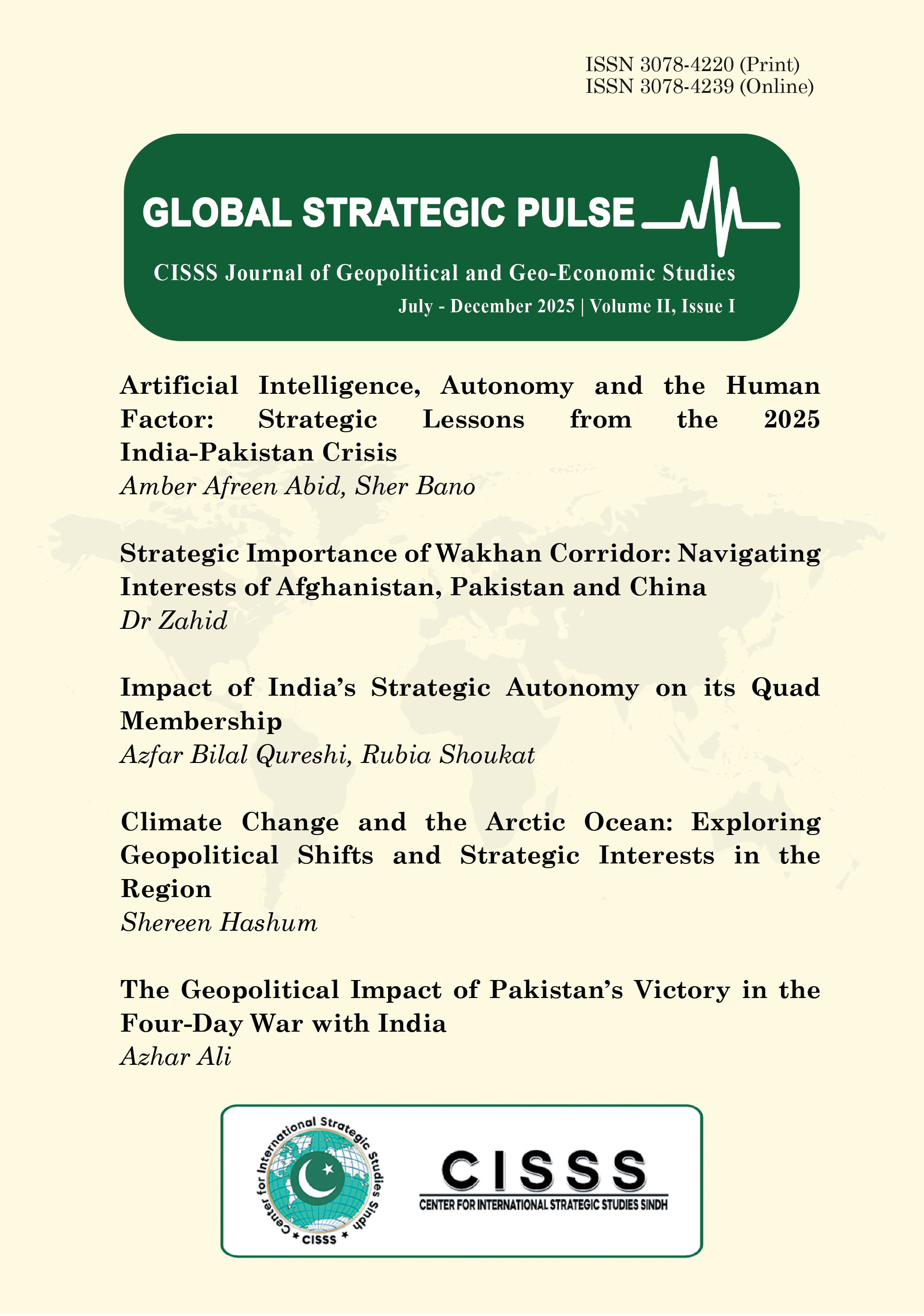
Climate Change and the Arctic Ocean: Exploring Geopolitical Shifts and Strategic Interests in the Region
DOI:
https://doi.org/10.64988/ven0pg49Keywords:
Arctic Region, Climate Change, Geopolitical Competition, Strategic Interests, Mineral ResourcesAbstract
Climate change is constantly transforming the Arctic region. The melting of its ice cap creates many opportunities for states, which rather results in competition among major powers than cooperation. The Arctic has been a significant political topic since the Cold War, transitioning from a potential conflict zone to an area of collaboration in the post-Cold War era. However, the evolving landscape of the Arctic is renewing the geopolitical dynamics and strategic interests among major powers, especially the US, China and Russia. Recognizing the Arctic’s growing strategic importance, both Arctic and non-Arctic states are redefining their regional policies with a shift from cooperation to competitiveness and strategic assertion. This article explores the evolving geopolitical and strategic landscape of the Arctic, focusing on how climate-induced accessibility and resource abundance are transforming the region into a potential zone of conflict. It will analyze the implications of vast untapped natural resources and emerging shipping routes for global power dynamics. Furthermore, the study aims to assess how heightened competition and assertive national policies are shaping new geopolitical alignments in the region, undermining the existing Arctic governance mechanism, in particular posing challenges to the Arctic Council and the UNCLOS.
Downloads
Published
Issue
Section
License
Copyright (c) 2025 Shereen Hashum (Author)

This work is licensed under a Creative Commons Attribution 4.0 International License.
All articles are permanently available online to the public without restrictions or subscription fees. All articles are free to be used, cited, and distributed, on condition that appropriate acknowledgement is included. Authors are the copyright holders of their original contributions. The published article is simultaneously licensed under a Creative Commons (CC) Attribution License. “A CC license is used when an author wants to give people the right to share, use, and build upon a work that they have created” Wikipedia.