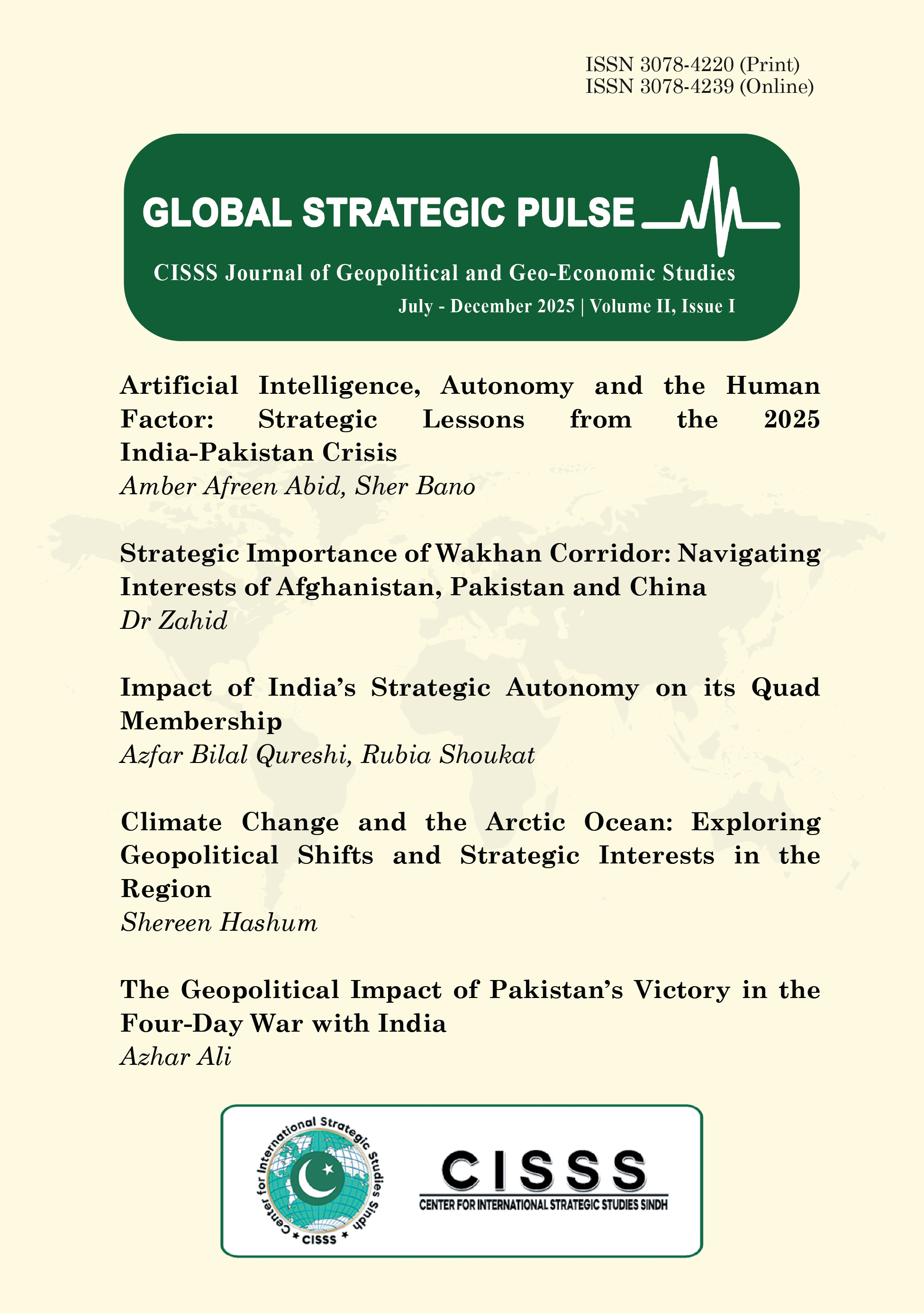
Strategic Importance of Wakhan Corridor: Navigating Interests of Afghanistan, Pakistan and China
DOI:
https://doi.org/10.64988/k40z5846Keywords:
Wakhan Corridor, Silk Route, BRI, CPECAbstract
The Wakhan Corridor is a narrow strip of land in northeastern Afghanistan. Historically, it served as a “buffer zone” established by the “Tsarist Russia” and the “British Empire” during the “Great Game” competition to avoid direct conflict between the two superpowers. The ancient “Silk Route” passed through this Corridor until the mid-15th century, as it was the primary trade route between the East and the West. As Western powers discovered new sea and land routes, the Corridor lost its significance. However, in recent years, with the rise of new economic projects such as CPEC, BRI, oil and gas pipelines and power transmission lines, the Corridor has regained the interest of regional powers, which are seeking its revival. This research is based on a qualitative approach, relying on secondary sources. Data was collected from research papers, newspapers and internet sources. This paper explores the interests of Afghanistan, Pakistan and China in the Wakhan Corridor and examines its potential as a connectivity link between Central and South Asia. The study emphasizes that investment in this Corridor will foster economic prosperity in the region. A key finding of the study is that this project is likely to strengthen regional connectivity and open new avenues for economic cooperation with significant implications for the broader geopolitical landscape.
Downloads
Published
Issue
Section
License
Copyright (c) 2025 Zahid (Author)

This work is licensed under a Creative Commons Attribution 4.0 International License.
All articles are permanently available online to the public without restrictions or subscription fees. All articles are free to be used, cited, and distributed, on condition that appropriate acknowledgement is included. Authors are the copyright holders of their original contributions. The published article is simultaneously licensed under a Creative Commons (CC) Attribution License. “A CC license is used when an author wants to give people the right to share, use, and build upon a work that they have created” Wikipedia.