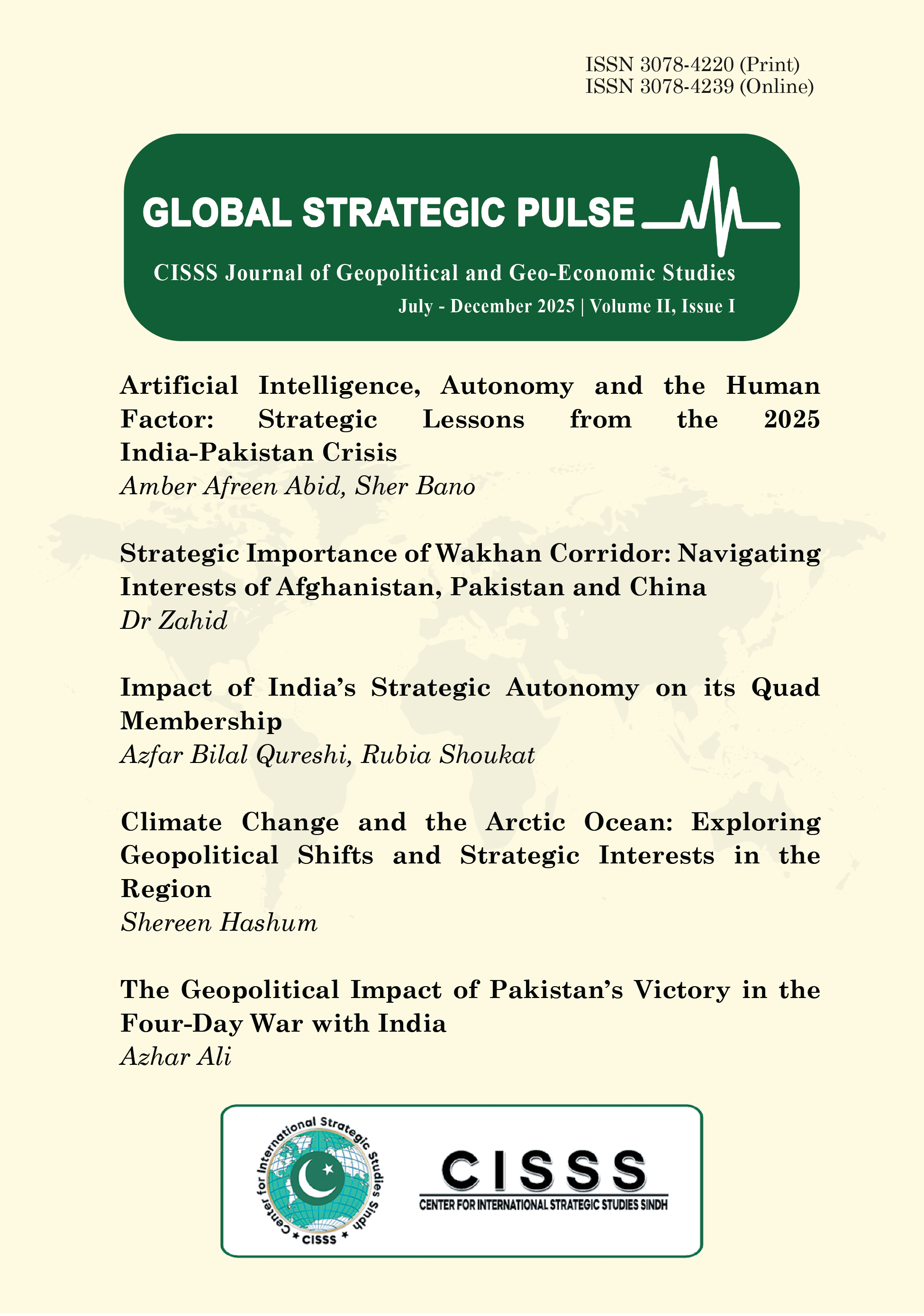
Artificial Intelligence, Autonomy and the Human Factor: Strategic Lessons from the 2025 India-Pakistan Crisis
DOI:
https://doi.org/10.64988/wwxvd071Keywords:
Artificial Intelligence (AI), Strategic Stability, Doctrine, Intelligence, Surveillance, and Reconnaissance (ISR), South Asia SecurityAbstract
This study critically examines the 2025 India-Pakistan crisis, highlighting the failure of India’s Artificial Intelligence (AI)-centric, space-integrated, military strategy and the decisive success of Pakistan’s human-led, doctrine-driven response. Despite India’s substantial investment in militarized AI, satellite-based Intelligence, Surveillancet and Reconnaissance (ISR) networks and Autonomous Weapon Systems (AWS), its overreliance on algorithmic warfare led to operational paralysis, strategic misjudgment and ultimate defeat. In contrast, Pakistan’s victory stemmed from superior command and control, adaptive air and cyber operations and a national culture of resilience and unity. Through effective integration of manned reconnaissance, electronic warfare and moral resolve, Pakistan neutralized India’s technological advantage. The conflict underscores enduring truths about warfare: technology cannot replace human judgment, institutional discipline or strategic clarity. As South Asia enters a new era of AI and space militarization, Pakistan’s conduct offers a model of responsible deterrence, emphasizing selective modernization, defensive innovation and strategic restraint. This analysis reaffirms that the future of conflict will be shaped not only by machines but also by the intellect, willpower and adaptability of those who wield them.
Downloads
Published
Issue
Section
License
Copyright (c) 2025 Sher Bano, Amber Afreen Abid (Author)

This work is licensed under a Creative Commons Attribution 4.0 International License.
All articles are permanently available online to the public without restrictions or subscription fees. All articles are free to be used, cited, and distributed, on condition that appropriate acknowledgement is included. Authors are the copyright holders of their original contributions. The published article is simultaneously licensed under a Creative Commons (CC) Attribution License. “A CC license is used when an author wants to give people the right to share, use, and build upon a work that they have created” Wikipedia.