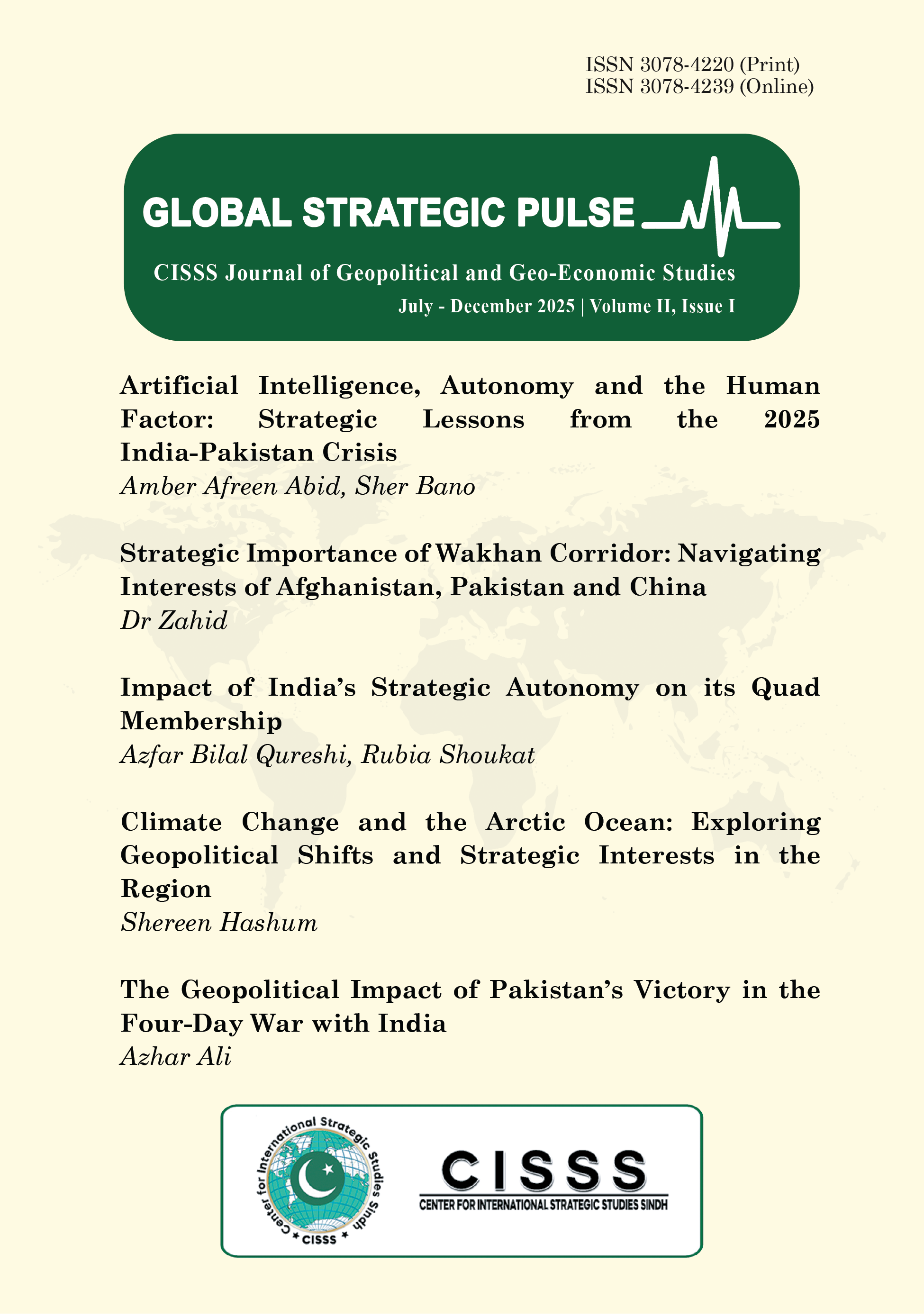
Impact of India’s Strategic Autonomy on its Quad Membership
DOI:
https://doi.org/10.64988/nt8b8n97Keywords:
India, Quad, China’s rise, Squad, South Asia, Strategic AutonomyAbstract
The Quadrilateral Security Dialogue (Quad), comprising the United States (US), Australia, India and Japan, evolved in the wake of the Indian Ocean Tsunami of 2004. It was revitalized in 2017 as a strategic alliance addressing a range of security and economic issues. The collaboration within the Quad intensified in response to China’s growing influence in the Asia-Pacific region, later renamed “Indo-Pacific” by the US with the release of the “Indo-Pacific Strategy” in February 2022. However, India’s role within the Quad adds to the complexities due to its strategic relations with Russia, economic compulsions vis-à-vis China, membership of SCO and BRICS, and internal socio-economic challenges. India heavily relies on Russian defence equipment, from which it cannot decouple anytime soon. It has also become the largest importer of Russian oil after the Ukraine crisis. India is increasingly perceived as an unreliable Quad partner due to its preference for strategic autonomy, rather than aligning with the US policy. The US has therefore been focusing on alternative alliances, such as the Squad, to use it as a bulwark against China. President Trump’s slogan of “Make America Great Again” (MAGA) and imposition of tariffs on friends as well as foes have not only raised questions about the future of the Quad and other minilateral alliances in the Asia-Pacific but also about the relevance of India as a US ally in the region. This paper examines the dynamics of the Quad, highlighting the paradox of India’s role as a “net security provider” in South Asia assigned by the US and its incapability to perform this role. Using a realist theoretical framework, the analysis highlights the strategic factors influencing the behaviour of the Quad member states, the challenges arising from India’s duplicitous position in the regional security architecture and the impact on stability in South Asia.
Downloads
Published
Issue
Section
License
Copyright (c) 2025 Lt Col Azfar Bilal Qureshi TI (M) (R), Rubia Shoukat (Author)

This work is licensed under a Creative Commons Attribution 4.0 International License.
All articles are permanently available online to the public without restrictions or subscription fees. All articles are free to be used, cited, and distributed, on condition that appropriate acknowledgement is included. Authors are the copyright holders of their original contributions. The published article is simultaneously licensed under a Creative Commons (CC) Attribution License. “A CC license is used when an author wants to give people the right to share, use, and build upon a work that they have created” Wikipedia.