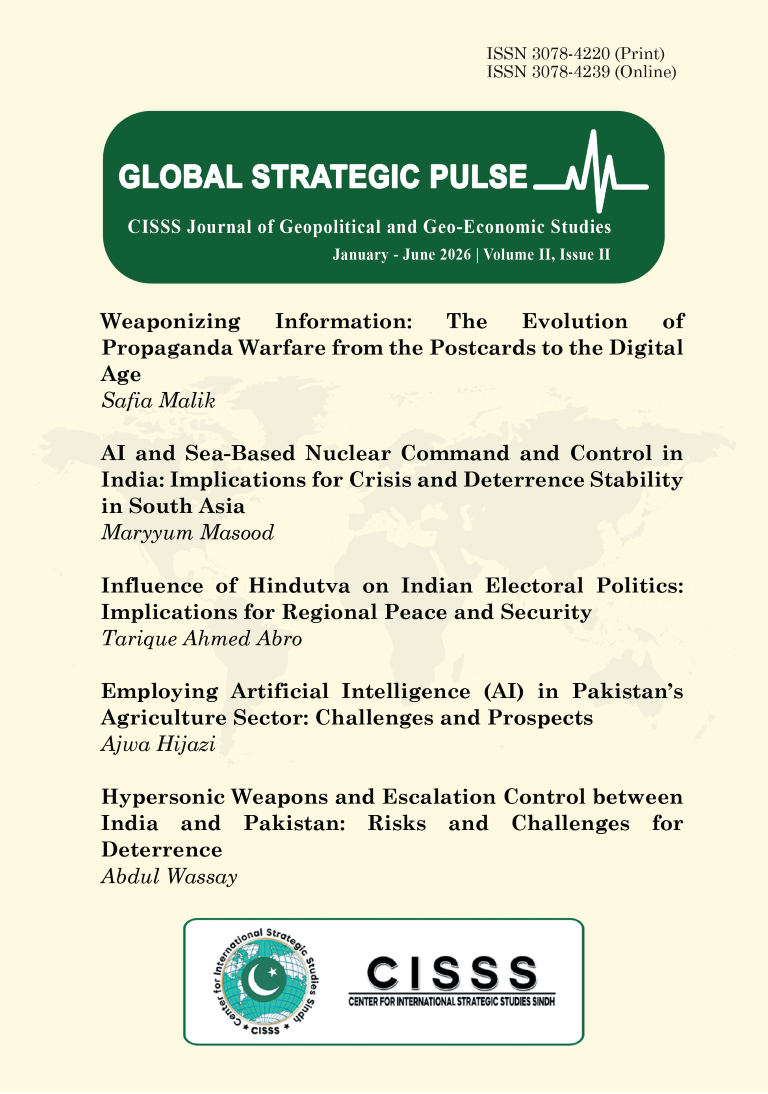
AI and Sea-Based Nuclear Command and Control in India: Implications for Crisis and Deterrence Stability in South Asia
DOI:
https://doi.org/10.64988/ndxfst43Keywords:
Artificial Intelligence, Sea-based Nuclear Command and Control, India, Pakistan, Crisis Stability, Deterrence Stability, South AsiaAbstract
This paper examines how India’s expanding use of AI-enabled capabilities in naval sensing, undersea surveillance analytics, communications support, and cyber defence is reshaping the information environment that conditions nuclear command and control (NC2) for its sea-based deterrent, and assesses the implications for crisis and deterrence stability in South Asia, with particular focus on Pakistan. India’s Arihant-class SSBN force is designed to provide survivable retaliation under conditions of concealment, isolation, and constrained connectivity. Open sources do not substantiate any role for AI in nuclear launch authorisation or automated nuclear decision-making. The paper therefore treats AI as an enabling variable within sea-based NC2, arguing that AI’s strategic significance lies in how it compresses and prioritises information, reduces decision latency for command-relevant judgments, and shapes force-protection behaviour around SSBN survivability in a verification-poor maritime environment. The study identifies crisis stability risks arising from AI-assisted classification under ambiguity, including compressed decision windows, automation bias in interpreting machine-generated alerts, and escalatory action–reaction dynamics when precautionary NC2 measures are misread as intent. It also highlights NC2-adjacent vulnerabilities associated with cyber intrusion, spoofing, and adversarial data manipulation across sensor-to-decision pipelines, as well as the heightened risk of third-party interference in the maritime domain where attribution is difficult. The paper further argues that improvements in AI-enabled undersea awareness may narrow uncertainty around submarine activity and intensify perceived pressures on the concealment and ambiguity that underpin Pakistan’s sea-based second-strike posture, which relies on nuclear-capable SLCMs deployed from conventional submarines rather than SSBNs. The paper concludes by recommending stronger human oversight and layered verification for AI-assisted NC2 functions, maritime crisis communication and incident-management mechanisms, and restraint-oriented norms discouraging destabilising AI applications in NC2.
Downloads
Published
Issue
Section
License

This work is licensed under a Creative Commons Attribution 4.0 International License.
All articles are permanently available online to the public without restrictions or subscription fees. All articles are free to be used, cited, and distributed, on condition that appropriate acknowledgement is included. Authors are the copyright holders of their original contributions. The published article is simultaneously licensed under a Creative Commons (CC) Attribution License. “A CC license is used when an author wants to give people the right to share, use, and build upon a work that they have created” Wikipedia.